The art of adaptive reuse begins before the acquisition.
By GTB Group · Jul 2026 · 5 min read
Every building we acquire has already lived a life. The discipline of adaptive reuse is deciding, with restraint, how much of that life to carry forward.
It is tempting to treat an old building as a good site with good bones — to gut it, maximize the square footage, and start fresh. We've learned to resist that instinct. The most valuable thing an older structure offers is precisely the thing a new build cannot buy: time, and the character that accrues with it.
The most successful conversions don't begin with what a building could become. They begin with understanding what made it worth keeping.
You can't manufacture patina
A church is built to make you feel something the moment you step inside — the height of the room, the way the light falls, the craftsmanship in every joint. That feeling is the product of a century, and no budget recreates it after the fact. When we walk a building for the first time, we catalogue what must be preserved as carefully as what must change.
A case in point: Casa Iglesia
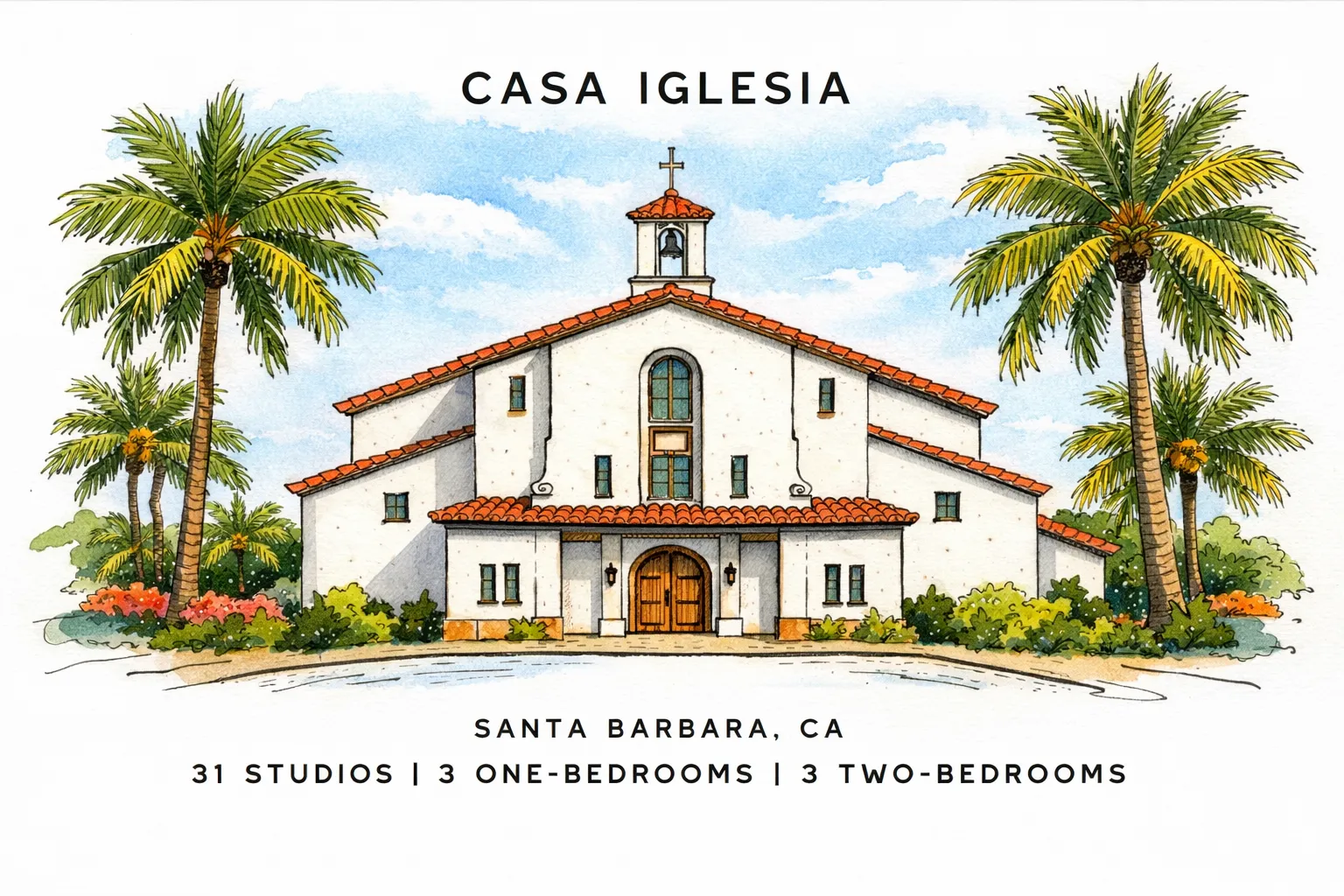
Casa Iglesia was, for most of a century, the First Christian Church of Santa Barbara — a 1920s landmark on Chapala Street. When we evaluated it, the honest question was not how many keys we could extract, but what we would be destroying to get them. Converting the sanctuary into apartments would have meant altering the floor plates and volumes that gave the building its meaning. A boutique hotel let us keep them.
So the sanctuary, the bell tower, and the original entry doors stayed. Rather than flatten the central volume, we opened the roofline into an open-air atrium at the building's heart — the height and light that once made the room feel sacred now anchor the hotel, with the original steel trusses left exposed overhead. A second floor was added within the former sanctuary and a third drawn from unused attic space, adding rooms without erasing the shell. The interiors take their cues from the building's own Spanish and Moorish vocabulary rather than imposing a new one.
Reuse is the more sustainable path — in practice, not just principle
Keeping a building is inherently less wasteful than replacing it, and we push the point further. At Casa Iglesia that meant an all-electric property powered by rooftop solar, existing infrastructure reused wherever it could carry a new purpose, and a pair of century-old olive trees planted to greet guests at the door.
Why the math works where others hesitate
Adaptive reuse is difficult, and the difficulty is the point. Converting office, retail, religious, or legacy lodging into hospitality means navigating entitlement, zoning, and structure — work that deters most buyers. We treat that complexity as a sourcing advantage. It lets us acquire well in markets where new supply is constrained by geography and regulation, then convert non-revenue square footage into rooms guests actively seek out.
Designed, built, and operated under one roof
Because we control every stage — acquisition, entitlement, construction, and operations — nothing is lost in the handoff between developer and operator. Our hospitality assets are run by ZenStay, a technology-first platform built to keep operating costs low and the guest experience high. The result is an asset that performs, and a place that feels inevitable rather than assembled.
Done well, adaptive reuse produces something that could only exist where it stands — a building that grew out of its city's history rather than being dropped into it. That is the standard we hold every project to.